Ein vollständiger Leitfaden für Schmuckmarken
Wie wählt man einen Schmuckkästchen-Organizer aus? Überlegen Sie sich zunächst, was Sie aufbewahren möchten, wie viel Platz jedes Schmuckstück benötigt, welche Fächer und Einsätze Sie bevorzugen, aus welchem Material die Box gefertigt sein soll und wie das Design insgesamt aussehen soll. Für Schmuckmarken und -händler sollte ein Schmuckkästchen mehr leisten, als Schmuck nur zu trennen – es sollte empfindliche Stücke schützen, eine ansprechende Präsentation ermöglichen und die Markenidentität stärken.
Für Unternehmen ist die beste Lösung oft eine individuell gestalteter Schmuckkästchen-Organizer Konzipiert für spezifische Schmuckprodukte. Ein gut gestalteter Organizer kann separate Fächer für Ringe, Ohrringe, Halsketten, Armbänder, Uhren oder andere Accessoires enthalten und ermöglicht es Marken, die Boxstruktur, Materialien, Farben, Bedruckung, Logoveredelung und Inneneinsätze individuell anzupassen.
Wichtigste Erkenntnisse
Warum ist ein Schmuckkästchen-Organizer wichtig?
Schmuck ist klein, zart und oft wertvoll. Ohne ordentliche Aufbewahrung können sich Halsketten verheddern, Ohrringe verloren gehen und Ringe leicht zerkratzt oder verlegt werden.
Ein Schmuckkästchen-Organizer löst diese Probleme, indem er separate Fächer für verschiedene Schmuckarten schafft.
Für eine Schmuckmarke spielt die Verpackung jedoch noch eine weitere wichtige Rolle.
Die Schmuckschatulle ist oft die erste physische Interaktion eines Kunden mit der Marke nach dem KaufBevor der Kunde das Schmuckstück selbst sieht, sieht er die Verpackung.
Eine hochwertige Schmuckschatulle kann daher Einfluss darauf haben, wie Kunden sie wahrnehmen:
Dies ist besonders wichtig für Luxusschmuckmarken, unabhängige Schmuckdesigner, Einzelhändler, E-Commerce-Verkäufer und Unternehmen, die Firmengeschenke anbieten.
Anstatt die Schmuckschatulle nur als Aufbewahrungsort zu nutzen, können Marken sie als Teil ihrer Strategie für Schmuckverpackungen.
Wählen Sie den passenden Organizer für Ihren Schmucktyp.
Im ersten Schritt gilt es festzulegen, was in der Schmuckschatulle Platz finden soll.
Unterschiedliche Schmuckprodukte erfordern unterschiedliche innere Strukturen.
Ringe
Ringschlitze oder Ringrollen eignen sich ideal für Verlobungsringe, Eheringe, Moderinge und andere kleine Ringprodukte.
Die Einlage sollte jeden Ring sicher halten, ohne dass es für die Kunden schwierig wird, den Schmuck abzunehmen.
Ohrringe
Ohrringe benötigen in der Regel kleinere Fächer oder Schlitze. Bei Ohrsteckern sorgen separate Löcher oder kleine, einzelne Fächer für eine ansprechende Präsentation im Verkaufsraum.
Halsketten
Halsketten erfordern besondere Aufmerksamkeit, da sich die Ketten leicht verheddern können.
Ein Einsatz für Halsketten kann Haken, Schlitze oder einzelne Abschnitte enthalten, die die Ketten voneinander trennen.
Armbänder
Armbänder benötigen in der Regel größere Fächer als Ringe oder Ohrringe. Je nach Produktart kann der Einsatz mit einzelnen Kanälen oder gepolsterten Abschnitten gestaltet sein.
Uhren
Uhrenverpackungen benötigen üblicherweise ein größeres Fach und eine stützende Polsterung. Eine maßgefertigte Uhren- und Schmuckschatulle kann Uhrenpolster mit zusätzlichen Schmuckfächern kombinieren.
Für Marken, die mehrere Schmuckkategorien verkaufen, ein Schmuckkästchen-Organizer mit mehreren Fächern könnte eine flexiblere Lösung bieten
2. Größe und Kapazität berücksichtigen
Ein häufiger Fehler ist die Auswahl eines Schmuckorganizers nur nach seinem Aussehen.
Eine schöne Schachtel ist nicht unbedingt eine funktionale Schachtel.
Bevor Sie eine individuelle Schmuckschatulle in Auftrag geben, sollten Sie Folgendes beachten:
Bei B2B-Verpackungen ist es besonders wichtig, den eigentlichen Schmuck im Prototyp vor der Massenproduktion zu testen.
Eine für zierliche Ohrringe konzipierte Schachtel bietet beispielsweise möglicherweise nicht genügend Tiefe für einen größeren Anhänger. Ebenso kann eine Halskettenschachtel zwar ansprechend aussehen, aber nicht genügend Platz bieten, um ein Verheddern der Kette zu verhindern.
Der beste individuell gestalteter Schmuckkästchen-Organizer ist um das eigentliche Produkt herum konzipiert, anstatt das Produkt in eine Standardverpackung zu zwängen.
3. Wählen Sie das richtige Innenausstattungsmaterial
Die Inneneinteilung ist genauso wichtig wie die Außenseite der Schmuckschatulle.
Unterschiedliche Materialien können völlig unterschiedliche Kundenerlebnisse schaffen.
| Innenmaterial | Hauptvorteil | Geeignet für |
|---|---|---|
| Samt | Weiches und luxuriöses Erscheinungsbild | Luxusschmuck |
| Mikrofaser | Glatt und schützend | Feiner Schmuck |
| Pappe | Leicht und individuell anpassbar | Einzelhandel & E-Commerce |
| Schaum | Starke Dämpfung | Zerbrechlicher Schmuck |
| Beflockter Einsatz | Hochwertiges haptisches Erlebnis | Hochwertiger Schmuck |
| Geformter Papierbrei | Nachhaltigere Option | Umweltbewusste Marken |
Für hochwertige Schmuckverpackungen werden häufig Samt und Mikrofaser gewählt, da sie eine weiche Oberfläche bieten und eine luxuriöse Präsentation ermöglichen.
Für Marken, die Wert auf Nachhaltigkeit legen, können je nach Schmuckdesign und erforderlichem Schutzniveau papierbasierte Einlagen oder Lösungen aus Formfasern in Betracht gezogen werden.
Die richtige Wahl hängt vom Gleichgewicht ab zwischen Schutz, Erscheinungsbild, Kosten, Nachhaltigkeit und Markenpositionierung.
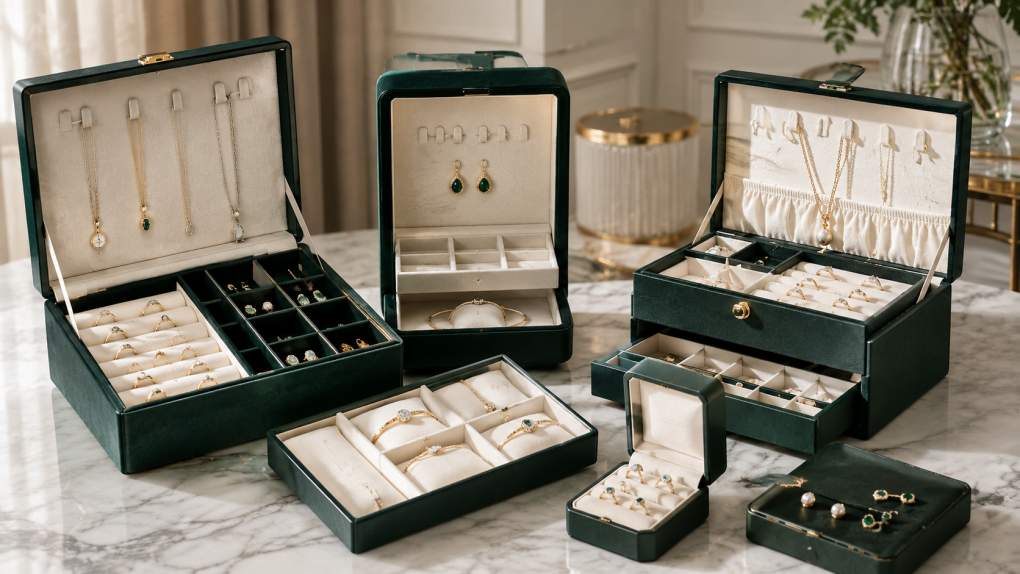
4. Entscheiden Sie sich zwischen Standard- und maßgefertigten Schmuckkästchen.
Für Verbraucher, die einen Schmuckorganizer für den persönlichen Gebrauch kaufen, kann eine herkömmliche Schmuckaufbewahrungsbox ausreichend sein.
Für Unternehmen bietet die Individualisierung jedoch deutlich mehr Flexibilität.
A individuelle Schmuckschatulle kann entsprechend den Produktabmessungen und der visuellen Identität der Marke entwickelt werden.
Die Anpassung kann Folgendes umfassen:
Kastenstruktur
Zu den gängigen Strukturen gehören:
Außenmaterial
Marken können verschiedene Papierstrukturen und Oberflächen wählen, um unterschiedliche visuelle Eindrücke zu erzeugen.
Zu den Optionen gehören beispielsweise:
Die Markenidentität kann gestärkt werden durch:
Für Luxusschmuckmarken kann ein schlichtes Logo mit dezenter Goldfolienprägung eine edle Optik erzeugen, ohne dass die Verpackung überladen wirkt.
5. Überlegen Sie sich etwas über Farbe und Markenidentität.
Die Farbe ist ein weiterer wichtiger Faktor bei der Auswahl eines Schmuckkästchens.
Unterschiedliche Farben vermitteln unterschiedliche Markenpersönlichkeiten.
| Farbrichtung | Markeneindruck |
|---|---|
| Schwarz + Gold | Luxuriös, hochwertig, anspruchsvoll |
| Smaragdgrün + Gold | Elegant, unverwechselbar, hochwertig |
| Weiß + Gold | Sauber, raffiniert, modern |
| Beige + Braun | Natürlich, warm, zeitlos |
| Zartrosa | Feminin, romantisch, modeorientiert |
| Marineblau + Gold | Professionell, erstklassig, klassisch |
Für B2B-Kunden sollte die Schmuckschatulle zur bestehenden visuellen Identität der Marke passen.
Eine beständige Kombination aus Farbe der Schmuckschatulle + Logo + Einlage + Veredelung kann die Verpackung sofort erkennbar machen.
Ein praktisches B2B-Beispiel: Gestaltung einer individuellen Schmuckschatulle
Stellen Sie sich eine Schmuckmarke vor, die die Markteinführung einer Premium-Halskettenkollektion vorbereitet.
Die Marke benötigt eine Verpackung, die:
Eine geeignete Lösung wäre beispielsweise eine stabile Schmuckschatulle aus Papier mit einem individuell gestalteten Einsatz.
Die Außenseite könnte aus dunkelgrünem, strukturiertem Papier mit dezenter Goldfolienprägung bestehen. Im Inneren könnte die Schachtel mit einem weichen Mikrofaser- oder Samteinsatz und einem separaten Fach für eine Halskette ausgestattet sein.
Für einen B2B-Hersteller wie z. B. AiretionDer Anpassungsprozess kann die Konstruktion, die Papierauswahl, den Druck, die Oberflächenveredelung, die Entwicklung von Einlagen, die Prototypenbestätigung und die Massenproduktion umfassen.
Das aktuelle Produktionsmodell von Airetion unterstützt kundenspezifische Papierverpackungslösungen mit typischen Mindestbestellmengen von rund 1.000–5.000 Stück, abhängig vom ProduktDie Herstellung starrer Geschenkboxen erfordert im Allgemeinen etwa 15–20 Tage nach Bestätigung, gemäß den Projektanforderungen.
Diese Art von Arbeitsablauf ermöglicht es Marken, Verpackungen um die eigentlichen Schmuckstücke herum zu entwickeln, anstatt einen generischen Organizer aus einem bestehenden Katalog auszuwählen.
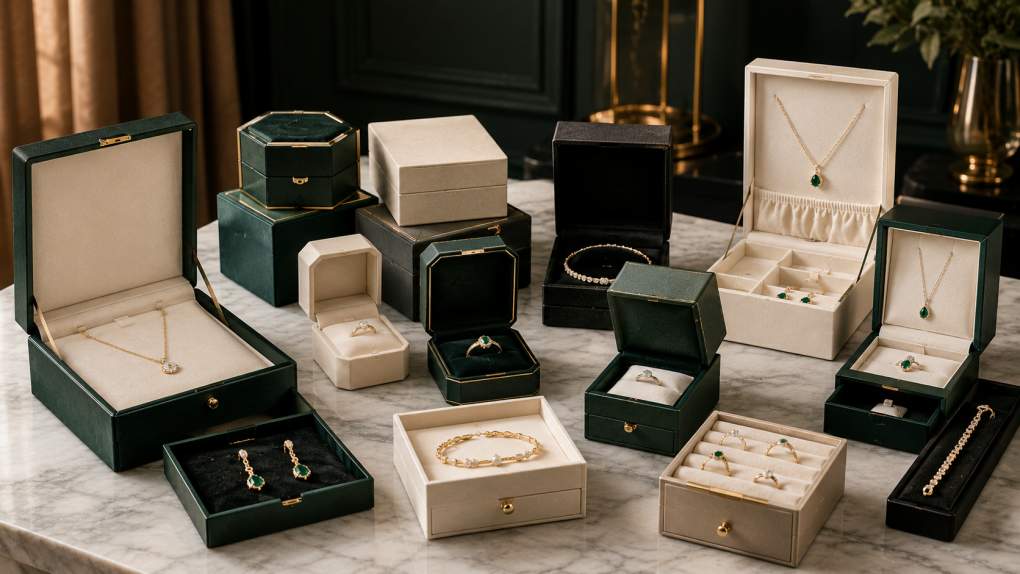
Wenn Sie Schmuckkästchen für eine Schmuckmarke, einen Einzelhändler, einen Großhändler oder ein E-Commerce-Unternehmen kaufen, stellen Sie dem Verpackungslieferanten vor der Bestellung die folgenden Fragen:
Prüfen Sie, ob der Lieferant die Abmessungen, die Struktur, das Papier, den Druck, die Veredelung, die Einlage und die Verpackung anpassen kann.
Ein Prototyp ermöglicht es Ihnen, das eigentliche Schmuckstück zu testen, bevor Sie mit der Massenproduktion beginnen.
Erkundigen Sie sich nach Folienprägung, Reliefprägung, Tiefprägung, UV-Druck, Spezialpapieren und anderen Veredelungsoptionen.
Die Mindestbestellmenge kann einen großen Einfluss auf die gesamte Kaufentscheidung haben, insbesondere bei neuen Schmuckmarken.
Bitte bestätigen Sie den Produktionsplan, bevor Sie Produkteinführungen oder saisonale Kampagnen planen.
Ein Lieferant, der in der Lage ist, mehrere Strukturen herzustellen, kann Ihnen mehr Flexibilität bieten, wenn Ihre Produktpalette wächst.
Es gibt kein Material, das für jedes Schmuckprodukt optimal ist. Samt und Mikrofaser sind für Luxusschmuck beliebt, da sie eine weiche und hochwertige Oberfläche bieten. Karton und Formfaser eignen sich für Marken, die leichtere oder nachhaltigere Verpackungslösungen suchen.
Welche Größe sollte meine Schmuckschatulle haben?
Wählen Sie die Größe entsprechend den tatsächlichen Abmessungen Ihres Schmucks. Die Schachtel sollte ausreichend Platz für den Schmuck und die Einlage bieten, ohne dass zu viel Leerraum vorhanden ist. Für B2B-Verpackungen empfiehlt sich die Anfertigung eines Prototyps mit dem tatsächlichen Schmuck.
Für Schmuckmarken bietet eine individuell gestaltete Schmuckschatulle in der Regel mehr Kontrolle über Passform, Markenauftritt, Inneneinteilung und Kundenerlebnis. Eine Standardschatulle eignet sich hingegen besser für die private Aufbewahrung oder kleinere Mengen.
Verwenden Sie dafür spezielle Haken, Schlitze, Kanäle oder einzelne Fächer für Halsketten. Der Einsatz sollte die Halskette fixieren und verhindern, dass sich die Kette während des Transports zu stark bewegt.
Ja. Je nach Verpackungslieferant und Material können Logos durch Druck, Gold- oder Silberfolienprägung, Prägung, Tiefprägung und andere Veredelungstechniken aufgebracht werden.
Luxusmarken wählen oft stabile Schmuckkästchen mit hochwertigem Papier, strukturierten Oberflächen, individuellen Einlagen und edlen Veredelungen wie Goldfolienprägung oder Reliefprägung. Das finale Design sollte jedoch die Positionierung der Marke widerspiegeln und nicht einfach nur zusätzliche Dekorationselemente enthalten.
Berücksichtigen Sie Mindestbestellmenge, Stückkosten, Verpackungsabmessungen, Material, Einlegeblattdesign, Oberflächenbehandlung, Produktionsvorlaufzeit, Versandabmessungen, Qualitätskontrolle und Prototypenfreigabe. Es ist außerdem wichtig sicherzustellen, dass der Lieferant das freigegebene Design in der Serienproduktion zuverlässig reproduzieren kann.
Der beste Schmuckkästchen-Organizer ist nicht einfach nur der, der schön aussieht.
Es sollte die richtige Kombination aus Organisation, Schutz, Präsentation, Markenbildung und Praktikabilität.
Für Verbraucher mag ein handelsüblicher Schmuckorganizer für die alltägliche Aufbewahrung ausreichen. Für Schmuckmarken und Geschäftskunden hingegen bietet eine maßgeschneiderte Lösung einen deutlich höheren Mehrwert.
Ein gut gestaltetes individuelle Schmuckschatulle kann Schmuck schützen, einzelne Stücke ordnen, die Markenidentität stärken, das Auspackerlebnis verbessern und einen hochwertigeren Eindruck erzeugen.
Bei der Auswahl eines Verpackungslieferanten sollten Sie nicht nur auf die Verpackung selbst achten. Prüfen Sie, ob der Lieferant Sie bei der Entwicklung einer kompletten Verpackungslösung unterstützen kann – von der Kartonstruktur und Materialauswahl über individuelle Einlagen, Bedruckung, Veredelung und Prototyping bis hin zur Serienproduktion.
Bei AiretionWir sind spezialisiert auf maßgeschneiderte Papierverpackungslösungen für internationale B2B-Kunden. Unser Leistungsspektrum umfasst individuelle Schmuckschachteln, stabile Schachteln, Geschenkboxen, Einlagen, Druck, Goldfolienprägung, Prägung und weitere Verpackungsveredelungen.
Ob Sie eine neue Schmuckkollektion auf den Markt bringen, Ihre bestehende Verpackung modernisieren oder ein völlig neues Schmuckverpackungskonzept entwickeln möchten – unser Team hilft Ihnen dabei, Ihre Verpackungsanforderungen in eine produktionsreife Lösung umzusetzen.
Ihr Schmuck verdient eine Verpackung, die auf Ihre Marke zugeschnitten ist.
Wählen Sie die Struktur. Wählen Sie das Material. Wählen Sie die Oberfläche. Gestalten Sie Ihre individuelle Schmuckschatulle mit Airetion.
Nehmen Sie noch heute Kontakt mit Airetion auf, um Ihre individuellen Anforderungen an Schmuckverpackungen zu besprechen und eine Verpackungslösung für Ihre nächste Bestellung anzufordern.


Urheberrechte © © 2026 XIAMEN AIRETION TECHNOLOGY CO. LTD.. Alle Rechte vorbehalten .




 IPv6 network supported.